Tuesday, October 19, 2010

Distance vs. Displacement


Continuing on in my posts in Introductory Physics, here I want to explain the difference between DISTANCE and DISPLACEMENT.

First of all, Distance is said to be a "scalar" property, which means that it is a quantity that has no direction associated with it, and is defined only by its magnitude. (Another scalar property is mass... all magnitude, no direction.) Conversely, Displacement is a "vector" property, which means that in addition to its magnitude, it also has a relative direction. (Another vector is velocity... it is defined by a magnitude AND a direction.)

With those definitions, we can differentiate distance and displacement even better. Imagine walking to school in the morning. The number of footsteps you have to take to arrive at school (the magnitude) describes the distance (maybe not the most convenient units, mind you!). If your school is straight up the street, or if you have to take a winding path through the park and over the tracks, the number of steps defines the distance... Direction is irrelevant in explaining the distance. You can walk 100 meters in a straight line, or 1000 meters turning left, right, left, and back again. The measured path you travel is the Distance.

On the other hand, Displacement DOES have direction associated with it. If you are going to school one day, and you go straight there, 100 meters up the street, your displacement is 100 meters North (or whatever direction). Now, on the next day, you have a doctor's appointment first, you have to drive 2000 meters up the street (past your school), and then afterwards you drive back the 1900 meters to your school. The DISPLACEMENT is 100 meters, because you end up 100 meters North of where you started. It doesn't matter the path you take to get there. You could travel around the world and back again, and you would still be displaced 100 meters from where you started. The DISTANCE, however, which has no direction but is just the footsteps (or whatever) you traveled, is much larger. On the first day, the distance is 100 meters. On the second day, you travel 2000 meters plus 1900 meters back, which is 3900 meters.

In summary, think of distance as the path taken to get somewhere, and describe it as some quantity without direction (eg. 50 meters away). Displacement is simply the difference between where you start and where you end, no matter the path taken, but considering the overall direction moved (eg. 25 meters to the right).

Hopefully that helps to explain Distance and Displacement. Drop me a line if you would like any more discussion.


Sunday, September 12, 2010

How to do Math with Significant Figures


Following up my general discussion of significant figures, and then my discussion of the rules of counting significant figures, in this post I will outline a few more rules of actually doing math with significant figures. There are only a few rules here, but this always seems to be the part that people make mistakes on... students and professionals alike. In using significant figures, which usually happens in scientific applications, the purpose is to ensure that the same level of precision is applied across your calculations.

For addition and subtraction, you have to break one of the rules that you have undoubtedly always been taught: carry all of your decimal places, and only round in your final answer. When using significant figures in these calculations, your final answer can only be as precise as your 'least precise' value.

Here's an example:

1.23 + 4.567 + 89.1011 + 121.3

In this example, the value with the least precision is the final one: 121.3. It only has one decimal place. As a result, your final answer CANNOT have any more precision than one decimal place. You can't be sure if it is 121.300000, or what is beyond the 3, and so your degree of precision must be just the one decimal place. Therefore, you perform this calculation as it appears, but you must round your final answer to one decimal place. In this case:

1.23 + 4.567 + 89.1011 + 121.3 = 216.1981 = 216.2

Subtraction calculations would work the same way.

For these types of calculations (addition and subtraction), it must be pointed out that the number of significant figures in your final answer does NOT depend on the number of sig figs in the original values.

As I mentioned above, you don't always have to carry your decimal places to the end. If this were a 2 part problem, perhaps like this:

1.23 + 4.567 + 89.1011 + 121.3 = x
x + 3 = y,

you would solve the first line to be x = 216.2, and then substitute this value into the second line, and add 216.2 + 3, which would give you the final answer of 219 (applying the same rule as above). You wouldn't have to carry all your decimal places over to the second part.

Hopefully that is clear enough of an explanation for addition and subtration.

For multiplication and division, the rule is the opposite. That is, the number of significant figures in your final answer is equal to the smallest number of significant figures involved in the calculation.

Here is an example:

5.56 x 2.998 = ?

We can see, based on the rules of counting significant figures, that there are 3 and 4 sig figs, respectively, in these two values. Therefore, our final answer must have 3 sig figs. So, instead of 16.66888, we would report 16.7 (3 sig figs). Otherwise, we would imply a degree of precision that was nowhere near what we were working with in the beginning.

I hope these explanations and examples have been helpful to explain some basic math functions involving significant figures. As always, please comment with any questions you might have! :)


Monday, September 6, 2010

Introductory Physics - Changing Units and Dimensional Analysis


With the start of a new school year, I'm going to try to post more frequently and to also include Introductory Physics concepts as well.

Before getting into those concepts though, I want to provide a quick tutorial for new students (or a refresher for others) on unit conversions, and then briefly discuss Dimensional Analysis. Understanding how to convert units can often point you to the correct way of solving problems. I previously posted on strategies that can be used for solving word problems, and also how to deal with unit conversions. I'll link to it from here, rather than going through it again. But please post comments and questions if there is anything more about it that you would like clarified.

Similar to unit conversions is Dimensional Analysis. What this is, is exactly what it sounds like... analyzing the dimensions of the problem. You need to make sure that the dimensions (units) of one side of the equation is equal to the dimensions (units) on the other. If they are not, you know you have done something wrong. Using a common example and knowing that velocity is equal to distance per unit time:

distance = velocity * time....
distance = (distance/time) * time....
distance = distance

Therefore, the dimensions of this equation make sense. You can similarly approach this by looking at the units, as described above and on the previous link.

meters = meters/sec * sec
meters = meters

The units make sense.

As you can see, Dimensional Analysis isn't as tricky as it sounds. You basically just check to make sure that the dimensions, or units, are the same on either side of the equals sign.

In my next posts, I would like to discuss Scientific Notation and Significant Figures... concepts that are notorious for giving students problems. I will try my best to clear things up. :)


Wednesday, June 2, 2010

What are Significant Figures?


Significant Figures are a concept that is introduced to students usually in Introductory Science courses, right near the beginning. However, it is a concept that continually confuses people, even beyond their school years. This is because, at first glance, Significant Figures appears to be the same as rounding... but there are many rules to follow, and that is where most of the difficulty arises.

As I said, the concept of Significant Figures ("sig figs") is associated with rounding, but there is more to it. It also describes the amount of uncertainty there is in a value, and is tied to that value's accuracy and precision. They are the digits in a value that are considered to be important, as a result of the precision in their measurement.

Here are a few basic examples:
  • A thermometer reads 26.9 degrees Celsius. This is 3 sig figs.
  • A scale displays a weight of 31.22 g. This is 4 sig figs.
  • A stopwatch shows 58.778 seconds. This is 5 sig figs.
So far, so good, right? Now, let's throw in a wrinkle. Sometimes, you don't count a zero as a Significant Figure. You ignore them ONLY IF they are at the very start of a number, such as before a decimal place, or at the very end of a number, such as 10.

Here are some more examples:
  • The number 0.232 has 3 significant figures.
  • The number 0.0076 has 2 significant figures.
  • The number 0.000000000000003 has 1 significant figure.
  • The number 100 has 1 significant figure.
  • The number 82000 has 2 significant figures.
  • The number 3,758,200,000,000,000 has 5 significant figures.
So, with those examples, you can hopefully now see how many significant figures a number with just a quick look.

Read on, where I will outline the general rules for determining the number of sig fig's, and also rules on how to do math with them.


Wednesday, May 26, 2010

The Distance Formula


This post is going to explain the distance formula: what it is, and where it comes from. When you see how to derive it, you won't need to worry about memorizing the formula anymore. And it's much easier than you think, despite looking kind of scary.  Please click the +1 button if this post helps you!

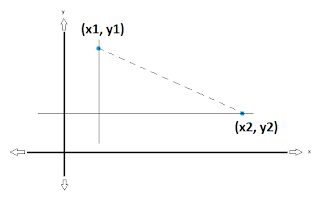
The distance formula is used to find the exact distance between two points, and can be easily explained with a right angle triangle to demonstrate it.

Assume that you want to find the distance between two points.  If you extend a horizontal line across from one point, and a vertical line through the other, these two lines will intersect at a right angle. You can then imagine the hypotenuse of this right angle triangle to be the distance between the two points in question.

How to derive the distance formula

From this, you can see that the distance between the two points is simply the length of the hypotenuse.

We already know that to find the length of the hypotenuse, we apply the Theorem of Pythagoras, which says that c2 = a2 + b2. (The square of the hypotenuse is equal to the sum of the squares of the remaining two sides). So from this, then, we see that we need to determine the lengths of the two sides that we have created by extending lines through our points to join at a right angle. And to find these lengths, all we need to know are the coordinates of our two points!

For a general triangle, then, we have something like this:

How to derive the distance formula

To find the horizontal length, it is just the difference between the two x-coordinates (ie. x2-x1). Think of it as taking a stick that is x2 units long, and chopping off a length of that stick that is x1 units long. The stick that you are left with, x2-x1, is the length of our horizontal side.

The same reasoning applies to find the vertical length, which is the difference between the two y-coordinates (ie. y2-y1). One comment I will make here, is that since we are talking about a length of a side, the length has to be the absolute difference between the two points (ie. you can't have a negative side length).

So then, for our general triangle, we have our two lengths, and let's call the hypotenuse "d" (as in, the distance between the two points).

How to derive the distance formula

So then, if we apply the Theorem of Pythagoras to this triangle we have created, we can come up with the distance formula very easily!

c2 = a2 + b2...... which we can change to read:
d2 = (x2-x1)2 + (y2-y1)2

And so we have:

d = sqrt [(x2-x1)2 + (y2-y1)2]

How to derive the distance formula

Let's quickly try with 2 points. You can draw the triangle out as I have above to follow along more closely. I will just do the quick calculation for you though.

Find the distance between the points (1,2) and (3,5).

d = sqrt [(3-1)2 + (5-2)2]
d = sqrt [(2)2 + (3)2]
d = sqrt [4 + 9]
d = sqrt [13]

And that's all there is to it. I hope that with this example calculation, I've been able to clearly explain how to derive the distance formula.  Once you know where a lot of these formulas come from, you'll never have to worry about memorizing them again!  If you learn how the derivation works first, then in time, you will automatically remember the formula.


Related Posts