Showing posts with label hypotenuse. Show all posts

Wednesday, May 26, 2010

The Distance Formula


This post is going to explain the distance formula: what it is, and where it comes from. When you see how to derive it, you won't need to worry about memorizing the formula anymore. And it's much easier than you think, despite looking kind of scary.  Please click the +1 button if this post helps you!

The distance formula is used to find the exact distance between two points, and can be easily explained with a right angle triangle to demonstrate it.

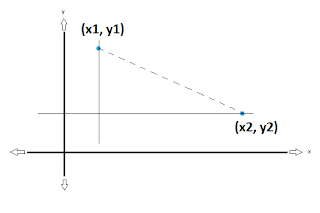
Assume that you want to find the distance between two points.  If you extend a horizontal line across from one point, and a vertical line through the other, these two lines will intersect at a right angle. You can then imagine the hypotenuse of this right angle triangle to be the distance between the two points in question.

How to derive the distance formula

From this, you can see that the distance between the two points is simply the length of the hypotenuse.

We already know that to find the length of the hypotenuse, we apply the Theorem of Pythagoras, which says that c2 = a2 + b2. (The square of the hypotenuse is equal to the sum of the squares of the remaining two sides). So from this, then, we see that we need to determine the lengths of the two sides that we have created by extending lines through our points to join at a right angle. And to find these lengths, all we need to know are the coordinates of our two points!

For a general triangle, then, we have something like this:
How to derive the distance formula

To find the horizontal length, it is just the difference between the two x-coordinates (ie. x2-x1). Think of it as taking a stick that is x2 units long, and chopping off a length of that stick that is x1 units long. The stick that you are left with, x2-x1, is the length of our horizontal side.

The same reasoning applies to find the vertical length, which is the difference between the two y-coordinates (ie. y2-y1). One comment I will make here, is that since we are talking about a length of a side, the length has to be the absolute difference between the two points (ie. you can't have a negative side length).

So then, for our general triangle, we have our two lengths, and let's call the hypotenuse "d" (as in, the distance between the two points).

How to derive the distance formula

So then, if we apply the Theorem of Pythagoras to this triangle we have created, we can come up with the distance formula very easily!

c2 = a2 + b2...... which we can change to read:
d2 = (x2-x1)2 + (y2-y1)2

And so we have:

d = sqrt [(x2-x1)2 + (y2-y1)2]

How to derive the distance formula

Let's quickly try with 2 points. You can draw the triangle out as I have above to follow along more closely. I will just do the quick calculation for you though.

Find the distance between the points (1,2) and (3,5).

d = sqrt [(3-1)2 + (5-2)2]
d = sqrt [(2)2 + (3)2]
d = sqrt [4 + 9]
d = sqrt [13]

And that's all there is to it. I hope that with this example calculation, I've been able to clearly explain how to derive the distance formula.  Once you know where a lot of these formulas come from, you'll never have to worry about memorizing them again!  If you learn how the derivation works first, then in time, you will automatically remember the formula.


Tuesday, April 24, 2007

Trigonometry - Tangent, SOHCAHTOA


So far, I've explained the concepts of Sine and Cosine... the third basic trigonometry function is TANGENT. If you've been following along and understanding those lessons, tangent isn't anything new for you. The tangent function of a right triangle relates an angle of the triangle to the ratio of its opposite side and its adjacent side. It does not refer to the hypotenuse at all. Referring to the same triangle we've been looking at, you can therefore see that:

TanB = b/a

In general terms, TanB = opposite/adjacent. We write "Tan" as the shorthand form for tangent.

Naturally, SOH CAH TOA helps us remember tangent as well. As you can probably guess by now, the "TOA" component stands for "Tangent is Opposite over Adjacent."

Again, try it out for yourself to see how all these functions work. See that in this triangle:

TanB = 3/4, so...
B = 36.87 degrees

These are the basic definitions for the standard trig functions, and they all work the same way to provide you with the same measurements for the angles or sides... the only things that are different are the sides that are being included in the ratios! So, pay attention to what sides you are looking at!


Monday, April 23, 2007

Trigonometry - Cosine, SOHCAHTOA


In continuing with my trig homework help series, this post will explain another of the basic trig functions, the cosine function.

Solving trigonometry problems that use the cosine function is extremely similar to the sine function explained in the last post. The cosine function relates an angle of a right angle triangle to the ratio of its adjacent side and the hypotenuse. The ADJACENT side to the angle is one of the sides that makes up the angle, but is not the HYPOTENUSE (the longest side of the triangle). Referring back to the same trig triangle we've been working with, it can be seen that side "a" is adjacent to angle B, and so:

CosB = a/c

In more general terms, CosB = adjacent/hypotenuse. We write "Cos" as the shorthand form of Cosine.

SOH CAH TOA helps us to remember the cosine function as well. The "CAH" term is short for "Cosine means Adjacent over Hypotenuse."

Take a look at the previous labeled trig triangle and see for yourself how the cosine function works. If you can do the sine function without problems, cosine shouldn't give you any difficulties either in your trig homework. Once again, it is absolutely important to understand the relative namings of the sides.


Sunday, April 22, 2007

Trigonometry - The Sine Function and SOHCAHTOA Explained


Solving trigonometry problems can be easy, but it first requires you to have a solid understanding of the basic trig functions.  There are three of these functions, and the first one I will discuss is SINE.  I will refer to the triangle pictured in the previous post.  In subsequent posts, I will highlight the other two functions: cosine and tangent.

The sine function relates an angle of a triangle to the ratio of its opposite side and the hypotenuse. So, if we look at angle B (and keeping in mind the notation for sides), we can see that:

SinB = b/c

In more general terms, SinB = opposite/hypotenuse. We write "Sin" as the shorthand form of Sine.

Similarly, SinA = a/c (again, it is opposite/hypotenuse... remember how I said it was important to understand the RELATIVE notation scheme!).

SOHCAHTOA is the trig acronym that describes the three basic functions and their ratios. It may be easier to see if you look at it with spaces: SOH CAH TOA. The one that we are interested in this post is the SOH term, which is short for "Sine is Opposite over Hypotenuse."  There are many other mnemonics that can be used to remember the order of these relationships, as you can see by the multiple comments below.  Thanks to everyone who submitted something!  As you can see, there is no one right way to have soh cah toa explained.  Whatever works for you to help you remember is all that is important.

Working with the Sine function is fairly straightforward, and usually just a matter of plugging the appropriate numbers into the ratio.

For example, you can imagine a triangle with known side lengths, and be asked to find the angles. This is a very common and simple question that you will get.  In this case, you would say Sin(B) = opposite/hypotenuse (where you substitute in the known values for the sides.) This will give you Sin(B) = "some value." And now, just as in working with addition or multiplication, when you want to solve for a specific variable, you have to isolate it... and to isolate it, you must do the same thing to both sides. Therefore, to get rid of the Sine, you must do 'inverse sine' to each side (which is usually the same calculator button, but pushing SHIFT to access it). Then you'll get B = inverse sine of (some value), which is your answer.  Technically, you are taking the arcsine of the ratio, though I will cover than in a future post in more detail.

Similarly, if you know a mixtures of some of the sides and some angles, you may be asked to find the unknowns. You can then say Sin(known angle) = opposite/hypotenuse (where one of these sides is known and the other unknown), and then just simply solve for the unknown side length.

Here's a quick triangle example:


So from this triangle, we can tell that:
SinA = (4/5)
SinA = 0.8 (now push inverse sin on your calculator...)
A = 53.13 degrees

Also:
SinB = (3/5)
SinB = 0.6
B = 36.87 degrees

A useful trick for quickly solving triangles is to understand that if you sum up the three angles, they will always total 180 degrees. So for this triangle, after solving angle A, you could subtract it and 90 from 180 to find B. Of course, this defeats the purpose of practicing Sine in this example... ;)

On the other hand, if we already knew that angle B = 36.87 degrees, and we wanted the length of the unknown hypotenuse, then we do:
Sin(36.87 degrees) = 3/hypotenuse
0.6 = 3/hypotenuse
hypotenuse = 3/0.6 = 5

As you can see, there really isn't anything complicated about performing these steps. For the most part, it's simple arithmetic with a few things about triangles thrown in for good measure.  I hope this explains the sine function so that it is understandable, and I also hope that now that you have had sohcahtoa explained, that makes more sense too. As always, please don't hesitate to comment if you're unsure or if you would like additional help. I'll discuss cosine and tangent in the next few posts.


Wednesday, April 18, 2007

What is Trigonometry?


Try asking any number of young math students the question "what is trigonometry?"  Inevitably, you will learn that it is one of the most feared subjects in math that students have to learn.  However, solving these questions and equations is much easier than they often give it credit for.  (For some interesting background history and applications of this discipline in mathematics, wikipedia has a good article.)  On this page I'm going to go over some of the basics to get you started.  Some of my following posts will go into more details on the specific functions, so be sure to check those out as well.  And please remember to hit the Like button and/or +1 button if this helps you at all.

Trigonometry Basics

Trigonometry, which literally means "triangle measurement," deals with the relationships between the angles and sides of triangles.  For the purposes of explaining the trigonometry basics, this is going to specifically deal with triangles that have one 90 degree angle (right-angle triangles).  These particular kinds of triangles have important distinctions to point out regarding their nomenclature.  The longest side, which is always the side that is directly opposite to the right angle, is called the HYPOTENUSE.  There is a common triangle notation of naming the sides and angles, as explained below, for which I will refer to this diagram:


The first concept that is essential for you to really understand is how to name a triangle.  The standard convention of naming triangles is to name them by the letters of their 3 corners. So in this example, this is triangle ABC. Similarly, the sides are named by the corners at either end of the side, so here we have sides AB, BC, and AC. The angles may be named with a single letter, or designated by 3 letters representing the points that make up the angle, in order, with the corner point in the middle (ie. angle B = angle ABC, angle A = angle CAB, angle C = angle ACB).

An alternate way to look at triangles is to name the ANGLES with capital letters. Then, the side that is directly opposite the angle is given the same letter, but in lower case. Therefore, from the above example, side AC = side b, AB = c, and BC = a. Somewhat confusing, but not really... it makes sense. The keyword in this method of notation is OPPOSITE, which tells you that the angle and the side opposite to it are related.  If this doesn't quite make sense to you automatically, you can also consider that the side c is the only one that doesn't help make angle C.  Check it out and see for yourself that this concept applies to all of the angles in any triangle.  If you can understand this basic naming scheme used in triangle problems, solving trigonometry questions will be that much easier.

In working with triangle sides and angles, you will also need to be able to recognize their RELATIVE positions.  So, in addition to the hypotenuse, which can easily be identified, the other two sides can be labeled relative to the angles.  So, this means that for angle B, you could be interested to label its OPPOSITE side and ADJACENT side. The opposite side is easy to identify: it is the side that does not touch the corner you are looking at. The adjacent side equally easy, though care must be taken to not mistake it for the hypotenuse: it touches the corner, but is not the hypotenuse.  Also recognize that in a right angle triangle, the two acute angles will always be created by an adjacent side and the hypotenuse.

A solid understanding of these trigonometry basics, including triangle notations and the naming of angles and sides (in particular, the relative naming designations) is important before you can move on to confidently do calculations involving these measurements. These calculations in themselves, however, are very straightforward, and as will be explained in separate posts, may be figured out very easily by remembering just one word - SOHCAHTOA.  This is one of the most important key points there is to memorize on this topic!  Make sure you check out some of my other posts (specifically, my lessons about sine, cosine, and tangent, where you will find sohcahtoa explained simply).

I really hope that I'm doing a decent job at explaining trigonometry easily.  Please hit the Facebook Like or +1 buttons to recommend my post if you found any value in it, and leave me some feedback in the comments below - especially if I didn't answer "what is trigonometry" well enough for you.


Related Posts